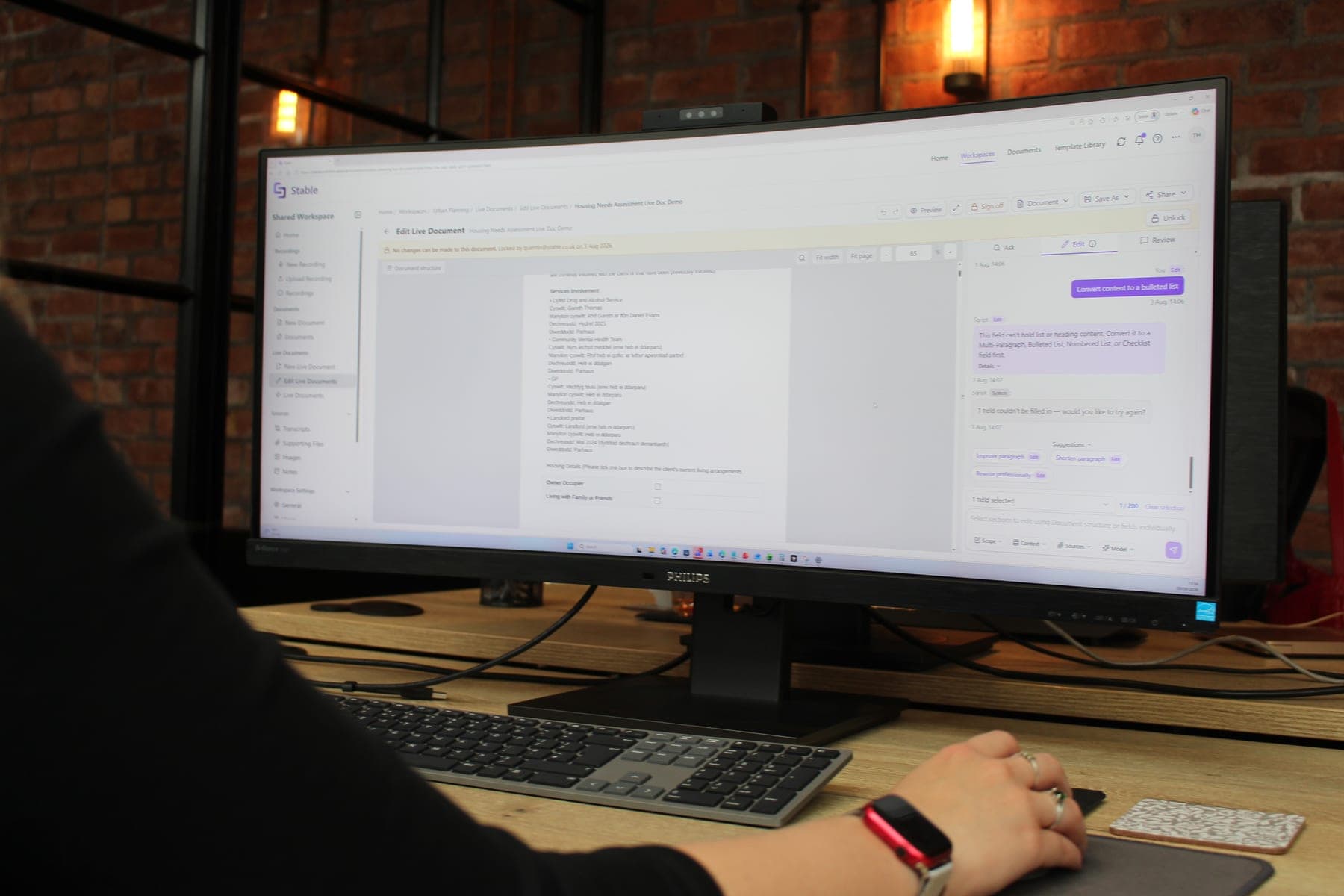
Making Human Oversight Real When AI Drafts First
As public sector organisations move from AI pilots to everyday use, the real challenge is no longer whether generative AI can produce a first draft but whether review and sign-off processes are strong enough to support it responsibly.
Generative AI can now produce a credible briefing, meeting summary or draft report in minutes. That speed is valuable. It can reduce the blank-page syndrome, save time and help teams move faster from notes to something usable.
It can, however, also change the nature of the review phase. When a document arrives polished and well structured, the temptation is to skim rather than interrogate. That is where the risk begins. In public sector settings, where documents often feed decisions, accountability and the official record, a quick sense-check is not the same thing as meaningful oversight.
What the Guidance Actually Requires
This is why the question of human control matters so much. The UK Government's AI Playbook makes clear that organisations need "meaningful human control at the right stages" and that humans should validate high-risk decisions influenced by AI (DSIT, 2025b). In practice, that means human involvement must be more than a final approval step. It has to include genuine scrutiny, clear responsibility and the ability to intervene when an output is weak, misleading or incomplete.
That conversation feels especially timely ahead of DigiGov Expo 2026. The event's focus on AI assurance, auditable governance and agentic public sector workflows reflects a broader shift in the market. The debate is moving beyond experimentation and into operational reality: how AI is used day to day, what controls sit around it and what trust looks like when the first draft comes from a machine rather than a person (DigiGov Expo, 2026a; DigiGov Expo, 2026b).
The opportunity is substantial. AI can help reduce repetitive drafting, improve consistency and give specialists more time to focus on judgement rather than formatting. For teams under pressure to produce more with limited resource, those gains are hard to ignore.
Three Concerns Worth Naming
Yet the concerns are just as real.
One is rubber-stamping. AI-generated text often sounds authoritative, even when its substance is shaky. The better the prose, the easier it becomes to miss errors, overstatements or missing nuance.
Another is drift. Over time, AI-assisted drafting can pull language away from approved wording, policy intent or organisational tone. That drift may be subtle but in regulated or high-accountability environments, subtle shifts matter.
Then there is the question of ownership. If an AI-assisted document later turns out to be wrong, accountability does not sit with the model. It sits with the organisation and with the people who reviewed and approved the content. That makes sign-off a governance issue, not an administrative one.
What Meaningful Review Looks Like in Practice
It starts with clarity. Who is responsible for checking substance, not just spelling or style? Can reviewers see what has changed between versions or are they only presented with a finished-looking output? Do teams have a clear route to challenge, amend or reject AI-generated content? Importantly, is the level of scrutiny proportionate to the risk attached to the document itself?
Not every internal summary needs the same level of review as a formal submission, decision note or public-facing report. If, however, AI is influencing content that informs decisions or becomes part of the record, organisations need to be explicit about where human judgement enters the process and what that judgement is expected to do.
The Direction of Travel
This matters all the more because the policy direction is towards wider adoption, not retreat. The AI Opportunities Action Plan makes the case for scaling AI where it can improve productivity and public services (DSIT, 2025a), while the One Year On update shows the emphasis is now firmly on delivery (DSIT, 2026). That raises the stakes for practical governance. It is no longer enough to say that a human remains "in the loop" if nobody can explain how that loop functions under real working conditions.
As public bodies explore more autonomous workflows, they will need to decide where delegation is appropriate and where human ownership should remain non-negotiable. For many document-led processes, especially those tied to accountability, policy interpretation or the official record, assisted drafting may prove easier to justify than fully autonomous generation.
That is not a conservative view. It is a realistic one. The promise of AI in public sector work is not just speed. It is the possibility of using time better: reducing repetitive drafting so people can spend more time on judgement, challenge and decision-making. Based on the evidence, that promise will only be realised if organisations build review and sign-off processes that are fit for AI-assisted work.
The question we should be asking ourselves is: if AI drafts first, what does meaningful oversight really look like?
References
Department for Science, Innovation and Technology (DSIT) (2025a) AI Opportunities Action Plan. Available at: gov.uk (opens in new tab) (Accessed: 9 September 2026).
Department for Science, Innovation and Technology (DSIT) (2025b) AI Playbook for the UK Government. Available at: gov.uk (opens in new tab) (Accessed: 9 September 2026).
Department for Science, Innovation and Technology (DSIT) (2026) AI Opportunities Action Plan: One Year On. Available at: gov.uk (opens in new tab) (Accessed: 9 September 2026).
DigiGov Expo (2026a) Sovereign AI & Agentic Government in the UK Public Sector. Available at: digital-government.co.uk (opens in new tab) (Accessed: 9 September 2026).
DigiGov Expo (2026b) DigiGov Expo. Available at: digital-government.co.uk (opens in new tab) (Accessed: 9 September 2026).