Building AI Workflows with Compliance Baked In
Looking at how AI can support documentation processes that traditionally rely on manual note-taking and reporting.
In regulated environments, the conversation about AI often starts with the shiny part: capability. How accurate is the transcription? How fluent is the summary? How “smart” is the model?
In the public sector, healthcare, legal, and other highly regulated environments, however, stakeholders quickly get to the question that really matters: can we govern it? If you can’t show how an output was produced, reviewed and approved then “innovation” doesn’t land as progress - it lands as risk or what some might perceive as a barrier to change.
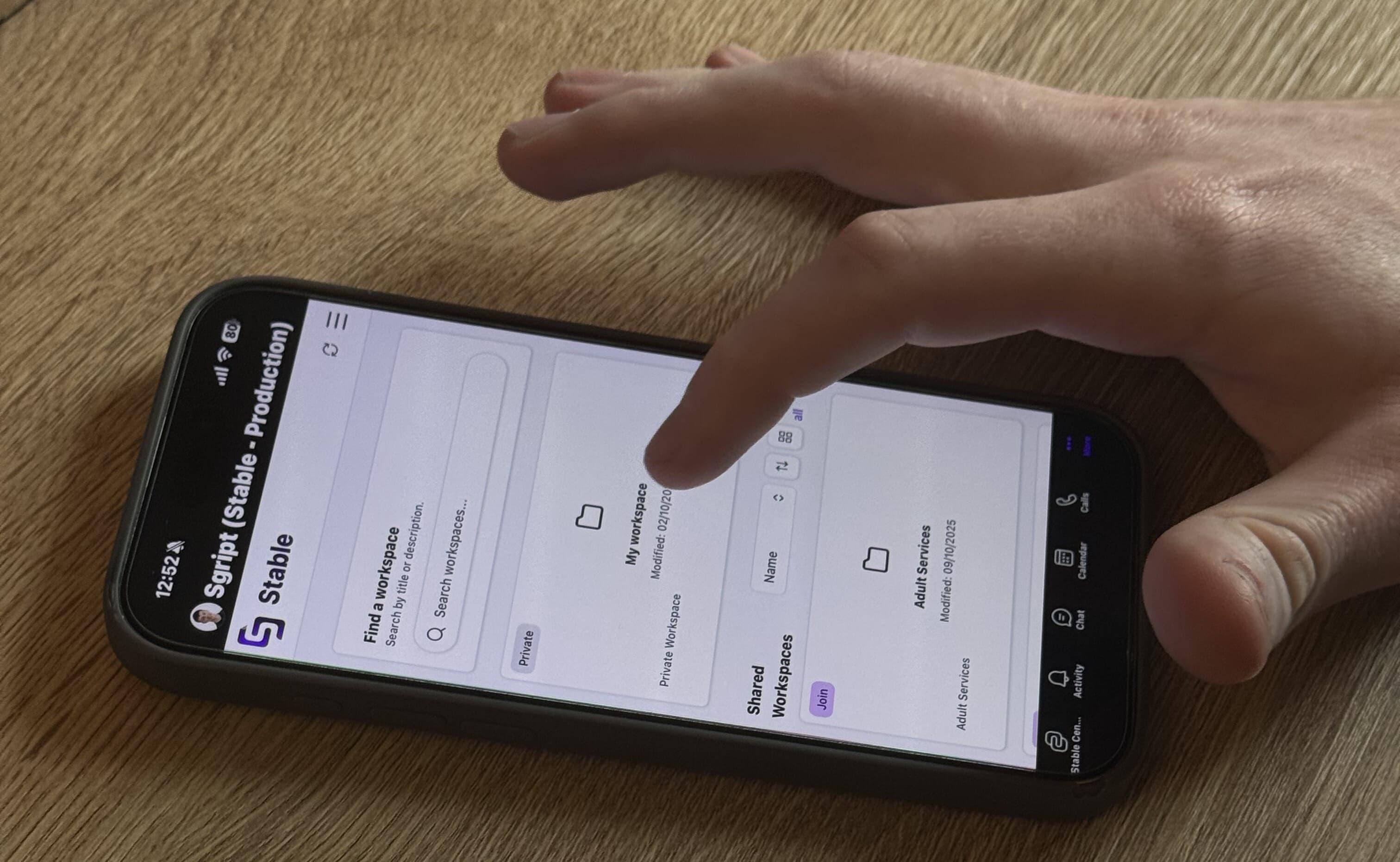
That’s the space Sgript is built to embrace as well as challenge. Instead of a generic “type anything” assistant, we designed Sgript to turn recordings, notes and supporting content into secure, structured drafts that match your organisation’s templates and workflows, then moves them through human review (human-in-the-loop), approval controls and audit trails.
Seen this way, “compliance” isn’t the paperwork you do at the end. It’s a set of non-negotiables you build off from day one - a bit like a blueprint: accountability, traceability, controlled access and predictable outcomes. UK GDPR makes this explicit: controllers must be responsible for and able to demonstrate compliance with the data protection principles (UK GDPR, https://uk-gdpr.org/chapter-2-article-5/ , accessed 16 April 2026). The Information Commissioner's Office (ICO) AI guidance reinforces the same idea: governance should be documented and embedded with clear roles, oversight and evidence of controls (ICO, 2026, https://ico.org.uk/for-organisations/advice-and-services/audits/data-protection-audit-framework/toolkits/artificial-intelligence/governance-and-accountability-in-ai/ , accessed 16 April 2026). These are the very foundations on which Sgript was built.
Constraint led design is where things get really interesting because those “non-negotiables” become practical features. Like building a house, you need to have a plan or blueprint to start with otherwise your job becomes a lot harder if not impossible. Responsible use of AI based on compliance constraints, for example, within an organisation is arguably an equivalent of an architect’s drawings, the AI responses based on those constraints, architect’s plan if you will, are the bricks. So, how does Sgript approach this? Sgript supports secure mobile and offline capture with synchronisation when connectivity returns, so field teams can keep moving without inventing unsafe workarounds. Outcomes are separated into purpose-built workspaces and an administrative tier helps manage access, licences and retention policies centrally. Deployment is flexible too: use Sgript as a fully hosted service or deploy into your own Microsoft Azure environment so data and processing remain within your organisational boundary (Sgript Product Guide.pdf, accessed 16 April 2026). In UK public-sector-aligned cloud thinking, clarity about “who is responsible for what” is itself a security control, captured in the NCSC’s shared responsibility model guidance (NCSC, https://www.ncsc.gov.uk/collection/cloud/understanding-cloud-services/cloud-security-shared-responsibility-model, accessed 16 April 2026).
That’s also why structured workflows tend to outperform free-text AI in secure settings. Free-text assistants can be brilliant in the moment but at scale they’re harder to govern. Prompts vary, outputs drift and reviewers end up re-checking everything because they can’t rely on consistent structure or a repeatable process, that said a human in the loop workflow is essential no matter if a similar document has been generated before.
When we designed Sgript we flipped that free-text dynamic by making structure the default. Templates work like guardrails (the blueprint again.): they constrain where AI can write, which fields must be completed and the tone required for the intended audience (through role management). The result is predictable drafts that are faster to review and easier to compare across cases (Sgript Product Guide.pdf, accessed 16 April). Outputs are generated as drafts with full human review, approval controls and audit trails, so accountability sits inside the workflow, not in someone’s memory or inbox (Sgript Product Guide.pdf). Sgript can produce web-form-ready structured data as well as reports, it reduces duplicate data entry across systems, one of the most common sources of delay and inconsistency in regulated services.
To conclude, if Sgript were a house - how would we describe it? Solid foundations built on industry recognised principles. Purpose built rooms, Workspaces. Reliable front door and window locks - secure, mobile online and offline capture. A kitchen to be proud of, the administrative centre is where access, licences and retention policies are controlled and templates built and shared with Workspaces. If you look under the stairs you have the consumer unit and stopcock: not glamorous but essential for safety and governance. You can even choose your plot (Deployment options) - software as a service SaaS or deploy within your own Azure boundary. Finally, think of Sgript less like a “chatbot” and more like a house built for a demanding environment - safe, secure, and designed for everyday use.